Eathquakes are vibrations that are producd when rocks break along a fault. When rocks pass their elastic limit they break or snap and the surfaces they move along when they break are called faults, this takes a tremendous amount of force. The earth is in constant motion and the plates under the crust are constantly moving, the plates move and when the rock is moved tension is created then released when the elastic point is reached.

A normal fault is where rock above the fault surface moves downward in relation to the rock below the fault surface. a fault or fault line is a planar fracture in rock in which the rock on one side of the fracture has moved with respect to the rock on the other side. Large faults within the Earth's crust are the result of differential or shear motion and active fault zones are the causal locations of most earthquakes.

A reverse fault is when the rock above a fault surface is forced up and over the rock below the fault surface. This is also known as a thrust fault. These faults can cause all types of things from volcanoes to earthquakes etc.

Most major faults in the United States, particularly in California, are what are known as strike-slip faults. A strike-slip fault is where rocks on either side of the fault are moving past each other without much upward or downward motion. Fault rupture of the ground generates vibrations-or waves-in the rock that we fell as ground shaking.
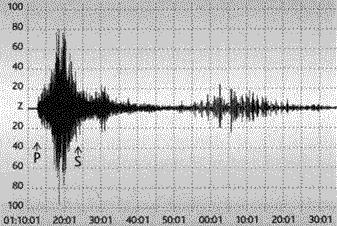
Seismic waves are waves generated by earthquakes, that travel through the earth. The point where waves/energy is first released is called the focus of the earthquake and is ussually found between 35-700km in the earth's surface ( the origin of seismic waves). When you measure seismic waves you use a sesimograph which tells tou the intensity of the earthquake by the lines recorded on it. There are several types of seismic waves and some of them are :

-
Primary Waves- which cause particles in rocks to move back and forth in the same direction that the wave was traveling, they are the fasest type of wave, and can travel through al earth materials.
-
Secondary Waves- Move through the Earth by causing particles in rocks to move a tright angles to the direction of the wave travel, they are slower than primary waves, and can't travel through liquid.
-
Surface Waves- move rock particles in a backward, rolling motion and side-to-side, swaying motion, they cause most of the descruction from earthquakes, and are the slowest wave
-
In the areas where there no waves occur at all these areas are called shadow zones, this is an area in which an S-Wave (secondary seismic wave) is not detected due to it not being able to pass through the outer core of the earth due to it being liquid. The point of the Earth's surface directly above earthquake's focus is called the epicenter and its the location that the waves first hit the earth's surface. To find the epicenter you need at least three different seismic waves readings to pinpoint exactly where it is. Once at a station seismic waves from earthquakes are measured with an instrument called a seismograph. The stationary pen traces a record of vibrations and from the lines recorded you can tell the intensity/type of the seismic waves.

The height of the lines traced on the paper record of the sesimograph is a measure of the energy that is released, or the magnitude of the earthquake. The Richter magnitude sclae is used to decribe the strength of an earthquake and is also based on the height of the lines on the siesmograph. For every 10X the line is bigger the energy exerted is 32X greater. The Richter sclae goes from 1.0-unkown, seismologists say the richter scale has no upper limit but they guess its about 9.5. Each year, about 55,000 earthquakes are felt but they cause little or no damage.
Earthquakes can cause alot of damage, and one type is liquefaction, where the wet soil under a building acts like a liquid when shaken and the soil sins causing the building to also sink, or collapse. Another type of damage an earthquake creates is a tsunamis which are ocean waves caused by seismic waves. These can be very dangerous and very big waves, because of the number of earthquakes that occur around the Pacific Ocean the threat of tsunamis is great.

Earthquake safety is very important, so quake-resistant structures have been creates, such as the moorings of some buildings have alternating layers of rubber and steel. The rubber acts like a cushion for the building, also buildings are reinforced to keep them up during an earthquake. Some areas such as California has these adaptations because they are used to earthquakes, but in some cases the are hit is not prepared and the earthquake can cause alot more damage there than in California. Earthquakes can be very dangerous so make sure your prepared, especially in a high earthquake area.
