A volcano is an opening in Earth that erupts gases, ash, and lava. Volcanic mountains form when laters of lava, ash and other volcanic material build up around these openings.moving creating volcanoes, and earthquakes. The area where the most volcanoes are found is along the boundaries of the Pacific Plate, because the plate is moving causing volcanoes and earthquakes. Actual volcanoes are formed when magma, hot melted rock material beneath Earth's surface, forced up and flows out onto Earth's surface through an opening called a vent.

Volcanoes ussually occur at two different type of plate boundaries or hots spots. The first time of plate boundary is a divergent plate boundary where two plates move apart causing lava to flow in the cracks/vents created from the plates moving apart. The second type of boundary is a convergent plate boundary when two plates push into each other and lava is forced up and under pressure forced out of the surface. Lastly hot spots are unusually hot areas at the boundaries between earth's mantla and core; that forms volcanoes when melted rock is forced upward and breaks through the crust.
There are two types of volcano eruptions that can occur. The first is a quiet eruption which is a non-explosive eruption where lava pours from volcanic vents and runs down the side of the volcano; this is caused by basaltic magma. The second type of volcano eruption is an explosive eruption where silica-rich or granitic magma which is thick and gas gets trpped inside creates a high pressure and huge explosion.

There are three main types of volcanoes and they are shield volcanoes, Cinder cone volanoes, and Composite volcanoes. Each volcano type has its own type of explosion and eruption. Also each type of volcano is shaped differently and is easily told apart from one another.
-
Shield volcanoes- Are broad volcanoes with gently sloping sides, and are created by basaltic lava in quiet eruptions. These volcanoes have flowing lava. They are built up slowly by the accretion of thousands of highly fluid lava flows called basalt lava that spread widely over great distances, and then cool as thin, gently dipping sheets. (below)
-
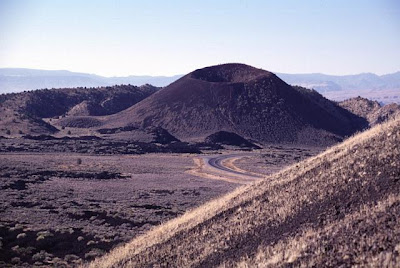
Cinder Cone Volcanoes- Are created by explosive eruptions with lava and cause rocks to be thrown high in the are. When bits of rock/solid lava (also known as tehra) fall it creates a steep sided, loosely packed cinder cone shaped volcano. Most cinder cones have a bowl-shaped crater at the summit and rarely rise more than a thousand feet or so above their surroundings. (below)
-
Composite volcanoes- Are broad cinder cone volcanoes. These volcanoes are formed by the alternating of quiet and explosive eruptions and is like a cinder cone and shield volcano put together. Lavas either flow through breaks in the crater wall or issue from fissures on the flanks of the cone. Lava, solidified within the fissures, forms dikes that act as ribs which greatly strengthen the cone.(below)


What controls the type of volcano is formed or the type of eruption made include serveral factors. One is trapped gases, which are gases trapped in magma by pressure, and is released as it nears the topf of a volcano; this high pressure cause volcano eruption. Another factor is water vapor, which gets caught in magma because of oceanic material and can cause volcanic explosions (this can be a type of trapped gas). Also, the type of tephra and amount of it will affect how or what type of volcano will form because of it.

Three types of lava
-
A'a' lava is the most common appearance type of lava flows that cool down forming fragmented, rough, sometimes spiny, or blocky surfaces. forms when the viscosity of the lava (e.g. because of high gas bubbles content and relatively low temperatures) and/or the strain rate of the flow (related mainly to eruption rate and steepness of the ground) are high. (below)

-
Pahoehoe is a common type of basaltic lava that cools down forming typical smooth, billowy, or ropy surfaces. Often, it forms by many small breakouts of lava from an over-crusted inflating flat, irregular flow. Pahoehoe lava forms from hot basaltic lava when the viscosity of the lava (e.g. because of low gas bubbles content and high temperatures) and/or the strain rate of the flow (related mainly to eruption rate and steepness of the ground) are low. (below)

-
Lastly there is pillow lava is lava that ozwes out of crack on the ocean floor. It forms pillow shape lumps as it cools, and is the most common type of lava on earth. They are created when magma reaches the surface but, as there is a large difference in temperature between the lava and the water, the surface of the emergent tongue cools very quickly, forming a skin.

-
Batholith- Largest intrusive igneous rock body that forms when magma being forced upward toward earth's crust cools slowly and solidifies underground.
-
Dikes- Igneous rock feature formed when magma is squeezed into a vertical crack that cuts across rock layers and hardens underground.
-
Sills- Igneous rock feature formed when magma is squeezed into a horizontal crack between layers of rock and hardens underground.
-
Volcanic necks- Solid igneous core of a volcano left behind after the softer cone has been eroded.
-
Caldera- Large, circular shaped opening formed when the top of a volcano collapses.
-
Craters- steep-walled depression around a volcano's vent.

